
What Adams County Property Tax Records Put on the Page
The tax trail runs from an assessment record to a Treasurer account. Both share a parcel key, yet each plays a different role. Always read the year and the office before comparing two figures.
| Record field | What it tells you | Official source |
|---|---|---|
| Parcel number and property type | The tax account and kind of taxable property | Treasurer bill, top-left area |
| Address or legal description | The land tied to the account | Treasurer bill and Assessor record |
| Market-value assessment | The Assessor's estimate under Idaho's market-value standard | Assessor roll |
| Exemption or relief | An adjustment that can reduce taxable value or amount due | Assessor and bill |
| District, levy, and tax dollars | Which taxing units receive each part | Treasurer distribution |
| Balance and delinquency | Current charge, payment state, and highlighted prior delinquency | Treasurer account |
A tax bill is not a sale record. The assessed figure is an administrative value built for the property-tax system. A deed or other sale source speaks to the transaction itself.
Three Roles Behind Adams County Property Tax
The Adams County Assessor keeps the parcel inventory. That means ownership for assessment purposes, land and improvements, classifications, values, and exemptions. The Treasurer handles the money side. This office bills and collects real, personal, and harvested-timber taxes. It also tracks special assessments and delinquency, and it runs the tax-deed process. Above both sits the Idaho State Tax Commission. It runs annual ratio studies and supplies equalization context.
Tax terms. Assessed value is the figure placed on property for the assessment system. Market value is the Assessor's estimate of what a typical buyer would reasonably pay. A levy is the rate a taxing district applies. The homeowner's exemption shields part of a primary residence's taxable value. It applies to qualifying owners. A tax lien is the public claim that attaches to unpaid property tax.
This division of labor explains the routing. Valuation questions go to the Assessor, while payoff questions go to the Treasurer. A recorded deed can change the ownership trail before the current tax account or mailing name catches up.
Look Up an Adams County Property Tax Bill by Parcel
The county links an online tax service. Its search fields are not described on the county's own pages, though. A reliable path works around that. Identify the exact parcel through the Assessor or the Adams County Parcels app first. Then take the parcel number to the Treasurer's official online, phone, mail, or in-person routes.
- Search the parcel map by property address or owner or mail name and copy the exact
PARCEL_ID. - Match the parcel number, property type, and address or legal description on the tax bill.
- Read the current distribution, taxable value, special assessments, credits, and balance for the stated year.
- Look for a prior delinquency highlight, but call the Treasurer for a complete prior-year payoff with current charges.
- Compare exemption and valuation questions with the Assessor record rather than treating the amount due as the assessment itself.
The Treasurer takes payment by mail, in person, online, and by phone. Stated methods include checks, cashier's checks, money orders, cash, and cards. The vendor adds a card charge, so confirm the current amount and fee before paying.
Adams County Property Tax Starts With a January 1 Value
In Idaho, nonexempt property is assessed at its market value on January 1. Adams County treats the tax roll as a continuing process. Taxable property gets appraised or indexed every year. Each parcel is physically reappraised at least once within a five-year cycle. A portion of the county goes through that process annually. The Assessor finishes the roll and delivers it by the fourth Monday in June. Along the way, land and improvements may be sorted into categories. These include agricultural and timber classifications where they apply. Keep in mind what a roll value actually is. It reflects one assessment date and nothing more. So it is not a live offer, a guaranteed sale price, or a lending appraisal. Anyone weighing a parcel number against market conditions should pause there. Treat the assessor's figure as a snapshot of taxable value. It is not a transaction-ready number.
One practical wrinkle involves office staffing. The county Assessor's current page names Kala Nichols, appointed in May 2026. An older FAQ still lists a former official's contact details. When two county pages disagree, trust the current office header. Do that before asking about a parcel, a deed record, or a tax bill.
Read the Adams County Tax Distribution and Total
The Treasurer FAQ describes the distribution as a list of taxing districts. It lists each levy, and the tax dollars assigned to it. In the county's telling, levy multiplied by taxable value yields the billed total. Certifications or special assessments then add to it. Credits, prepayments, circuit-breaker relief, or hardship adjustments can shrink what remains due.
Nearby parcels need not carry identical charges. The county GIS treats Tax Code Areas as a separate geographic layer. The bill itself identifies the actual distribution for the account. Water, fire, or local-improvement assessments can add charges that are not a private mortgage or deed restriction.
For what valuation figures mean apart from billing, the Adams County property value guide separates assessed value, market value, and sale evidence. On any tax question, the Treasurer's current account controls the amount to pay.
Adams County Property Tax Deadlines and Installments
Adams County sets the property tax due date at December 20. Two-installment payers owe the first half by December 20. The second half is due by June 20 of the following year. A deadline landing on a weekend slides to the next business day. Sub-roll or occupancy billing runs on its own calendar, with a February 20 due date. Confirm the property type and bill before assuming the standard real-property schedule applies.
The current bill shows only the current year's amount. A prior-year payoff includes interest and late charges. The Treasurer instructs callers to phone the office for those figures. Payments apply to the oldest balance first. A payment receipt and a zero current-year figure do not settle every prior-year question.
Follow Delinquent Adams County Property Tax Carefully
Missing the December 20 deadline costs money in Adams County. The Treasurer adds a 2 percent late charge on any unpaid first half. Interest then runs at 1 percent per month. It is figured daily from January 1. Partial delinquent payments on real property carry a $25 stated minimum. Each partial payment gets spread across the account proportionally.
Personal property and manufactured homes work differently. There, the FAQ says the entire unpaid tax bill comes due at once. Check the bill type before assuming that rule fits a real-property parcel in Adams County.
A tax deed is not triggered by one missed payment. The third-year deadline falls on December 31 before a pending tax-deed process begins. Idaho Code sections cited by the county require notices. Affidavits, publication, time limits, and a hearing also apply. Adams County publishes no public delinquent-property list. Ask the Treasurer directly for the status of a specific parcel number.
Adams County Exemptions and Relief Change Taxable Value
Adams County tax relief comes in two main forms. The county's materials point to the homeowner's exemption and the circuit-breaker program. The published homeowner description set relief at one-half of the home and garage value. The cap was $125,000 for 2022. That figure is dated. Confirm the current amount against the present application and Idaho rule before relying on it.
Calendar dates matter here. The Assessor lists March 15 and April 15 milestones for relief matters. The assessment notice and appeal cycle runs on its own June schedule. Ask which program, tax year, filing deadline, and proof apply to the parcel. Eligibility never follows from an owner name or mailing address alone.
Remember what an exemption actually does. It changes the taxable calculation on the tax roll. It does not rewrite the deed. It does not prove occupancy for every purpose or set a likely sale price. Keep the relief record, the assessment record, and the tax bill together in view. Each is a related but separate document.
A Historical Adams County Ratio Study Needs Context
A 2021 Adams County ratio study reported seven sales. It showed a 67.24 percent median ratio and a 71.90 percent weighted ratio. Those numbers are a historical benchmark from a small sample. They are not a current countywide forecast. They cannot fix the right value for one parcel.
Ratio studies exist to compare assessed values against sale prices. That comparison shows how level and uniform the appraisal work is across a county. The Idaho State Tax Commission keeps producing annual studies. The newer Adams County figures still call for their own look. Treat the 2021 numbers as a snapshot. Never use them as today's assessment ratio. They are no substitute for the current notice on file with the Assessor.
The old study can still be useful. It may help frame a fair question about uniform appraisal in Adams County. An appeal, though, should rest on parcel-level facts and suitable comparable properties. It should not lean on one broad percentage from years past.
Contest an Adams County Assessment on the Published Cycle
Start with the assessment notice itself. Adams County guidance asks property owners to review that notice first. Raise any concerns with the Assessor directly. Strong comparable sales share the same location. They also resemble the parcel in age, type, and condition. Timing matters too. Current-year sales generally shape the next assessment year. A later sale does not automatically prove the January 1 value at issue. For the active review process, check the official Adams County notifications and appeals page.
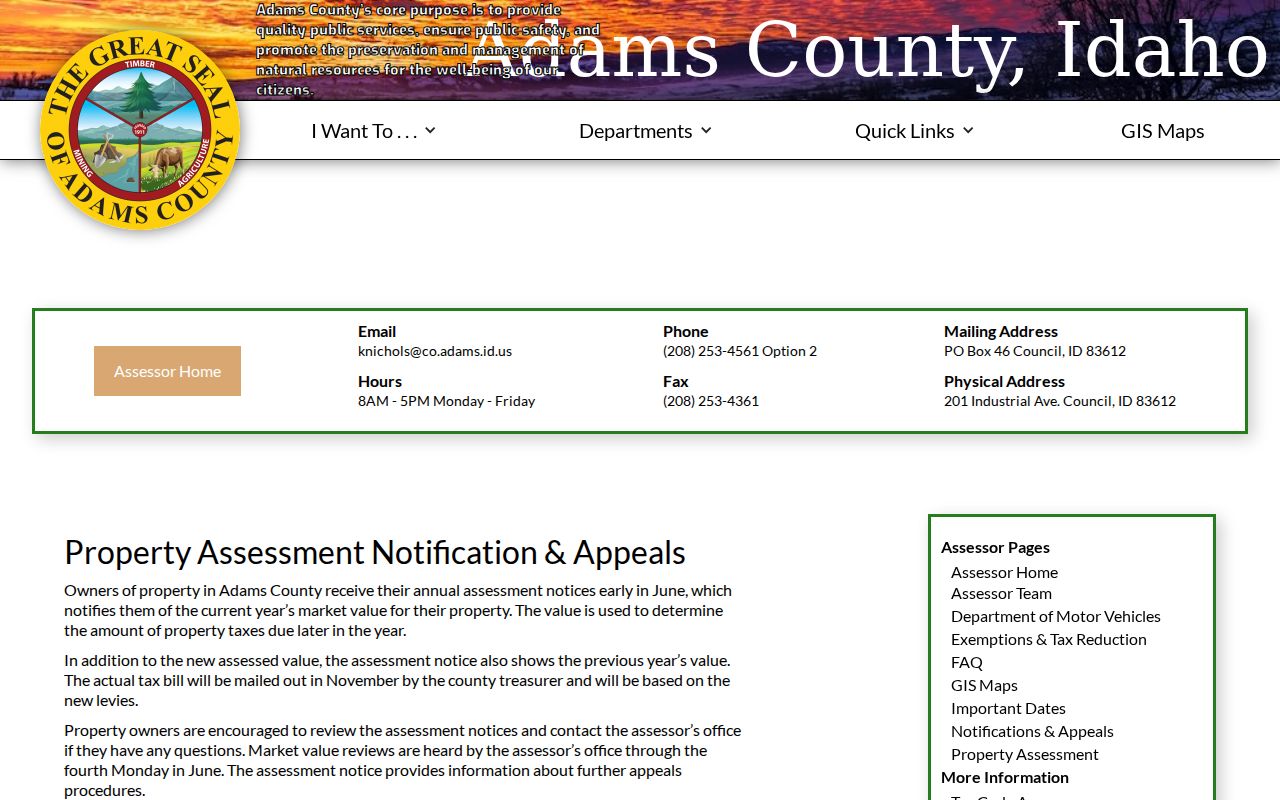
That official page lays out the local appeal route. But the parcel's own notice controls its value and filing details. If the issue is still open, follow the county's instructions for the Board of Equalization. The roll is completed by the fourth Monday in June. The published appeal window hangs on that calendar. Get the current form and exact deadline from the notice itself. Do not trust an old web date.
Act when the notice arrives. Adams County ties assessment appeals to the fourth-Monday-in-June cycle, so confirm the current filing cutoff and evidence rules at once.
An appeal targets valuation or classification. It does not overturn a recorded deed. Nor does it revisit the Treasurer's arithmetic once the roll is set. A dispute over a tax bill and a challenge to an assessed value may land in different offices with different deadlines.