
Compare Adams County Property Values
A value is only as good as its context. Adams County's Assessor estimates market worth for the assessment roll. A deed records one transfer on its own terms. An appraisal analyzes a stated property for a stated purpose and date. Before comparing amounts, compare sources and dates.
| Value Type | What It Means | Where It Is Recorded |
|---|---|---|
| Assessed value | The assessor’s value used in the tax system, subject to classification and exemption context | Adams County assessment roll and parcel records |
| Market value estimate | What the assessor estimates a typical buyer would reasonably pay as of the valuation date | Assessor valuation process and notice |
| Last sale or consideration | The amount or consideration tied to a specific recorded transfer, when the instrument discloses it | Recorder deed or transfer instrument |
The public ArcGIS schema lists estimated and improvement fields, yet labels on a live card can vary. A sale price, land split, or history may not appear there. When a field is missing or unclear, check the current Assessor office page instead of guessing.
Adams County January Property Value
Idaho law sets January 1 as the assessment date for nonexempt property. That single day anchors the whole valuation. A sale, remodel, fire, land split, or market swing that happens afterward belongs to a later snapshot. So an assessed value only speaks for its own year. The Assessor estimates what a typical buyer would reasonably pay, parcel by parcel. The office applies that standard fairly and uniformly across the county.
Treat the roll as a countywide administrative record rather than a one-off sale appraisal. Land and improvements fall into separate categories. Agricultural or timber classification can change how a value should be read. Exemption fields can lower taxable value without rewriting the deed history. Nor do they prove who currently occupies the property.
Note: Always read an Adams County assessed value with its assessment year and its January 1 status date.
Look Up Adams County Assessed Value
Start with the right parcel. The Assessor FAQ names the parcel number as the quickest lookup key for Adams County property records. The public map also supports searches by property address, parcel ID, and owner or mail name.
- Open the Adams County Parcels app and search the property address through
PM_PROP_AD. - Select the correct polygon and save its exact
PARCEL_ID. Compare the situs with the map location before reading value data. - Record the assessment year, stated value, classification, acreage, exemption, and improvement details that are actually shown.
- For a sale-price comparison, search the Recorder’s transfer instrument. Do not treat an unverified map field as a recorded price.
- Assessed value
- The value placed on the assessment roll for the tax system.
- Market value
- The assessor’s estimate of what a typical buyer would reasonably pay as of the valuation date.
- Assessment ratio
- Assessed value divided by sale or market value for a study comparison.
- Sale or consideration price
- The amount associated with one transfer, subject to the deed’s terms and disclosures.
- Reassessment
- A new review or update of a property’s value for the roll.
Adams County Value Review Cycle
Assessment work in Adams County never really stops. Taxable property is appraised or indexed every year. Each parcel gets a physical reappraisal at least once in a five-year cycle. The county runs an annual 20 percent appraisal program. That spreads physical review across the county instead of touching every parcel at once. The assessment roll is completed and delivered by the fourth Monday in June. Notices go out in late spring or early summer under the county calendar. Those roll dates explain valuation timing. But they say nothing about when an owner name updates after a deed records. Ownership freshness and valuation freshness connect only through the parcel record itself. The county property-assessment page walks through the annual and five-year process.
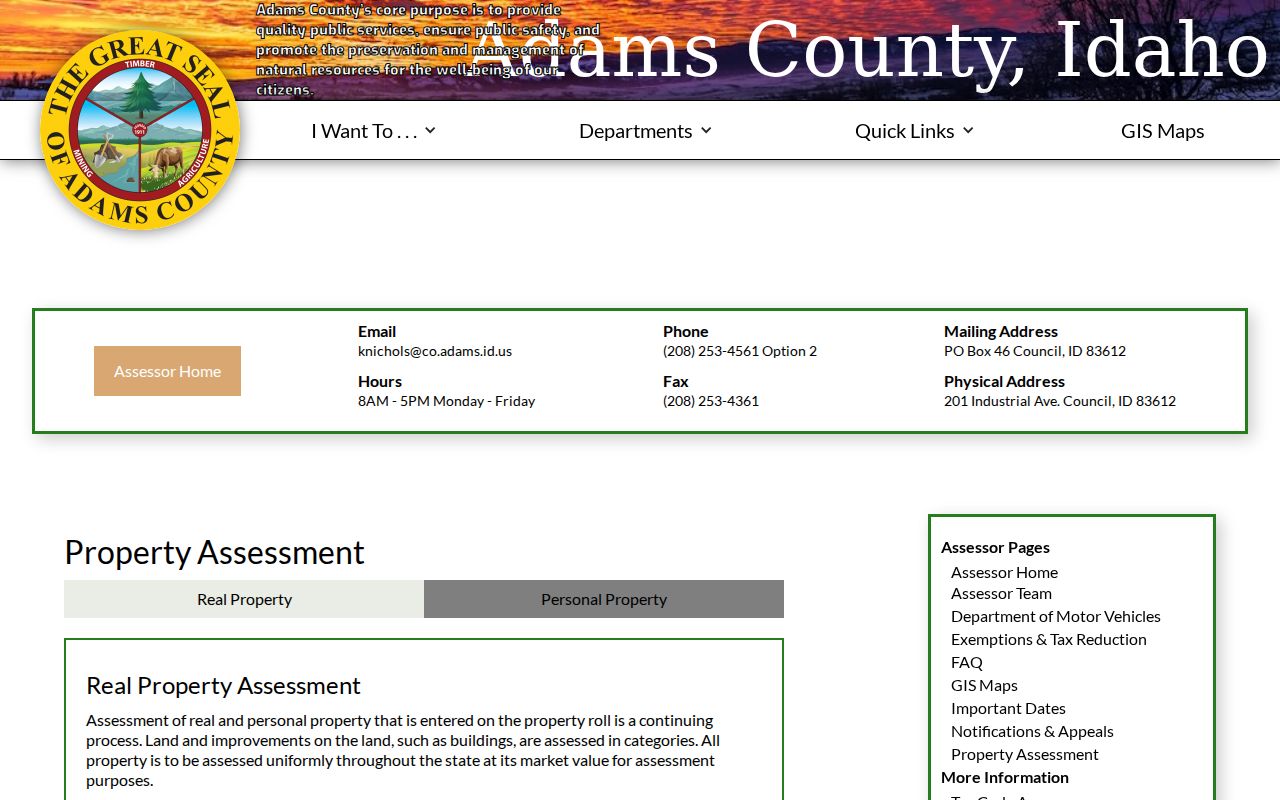
For the county's own method, the official page is the source to trust. A single parcel card is still what ties a value to one address.
Adams County Improvement Value Clues
A parcel database can show acreage, assessed value, homeowner exemption, timber or agricultural classification, and improvements, according to the Assessor FAQ. A related ArcGIS table holds fields for appraisal or inspection date, revision year, class or use, market grade, year built, effective year, estimated value, stories, rooms, floor areas, heating, garage data, and percent complete. These attributes explain why two nearby parcels carry different values. They cannot promise a structure's condition today. Schema alone also cannot prove every field appears in the current public popup. Before a purchase decision, confirm key characteristics with the Assessor and weigh them against permits, inspection records, and the physical property itself. Classification deserves extra care in Adams County. Rural orchard, farm, ranch, and timber history can produce land treatment unlike a city residence. Council history describes Mesa Orchards as a large orchard south of town, a reminder that acreage and agricultural context can matter more than a simple per-home comparison.
Read Adams County Ratio Studies
The Idaho State Tax Commission runs ratio studies. These compare assessed values against sale prices, and they gauge level and uniformity. A ratio is a study tool, not a multiplier that prices any one home. Sale samples, property classes, dates, and unusual transfers all limit what a published measure can support. One official 2021 Adams County figure reported seven sales. It showed a 67.24 percent median ratio and a 71.90 percent weighted mean. That sample is small and historical. It is not a current value, a county forecast, or proof that every parcel was assessed at those percentages. The Tax Commission ratio-study resources lay out the statewide method. They also offer the right place to check newer results. Use a ratio study to grasp the assessment system. Use the parcel roll for the assessed figure. Use deed records for a recorded transfer. Then rely on a qualified private appraisal for a current parcel-specific opinion.
Recorded Adams County Sale Price
Every sale amount belongs to one deal. The Adams County Recorder index is where that number lives. Search it by instrument number when you have one. You can also search by name, concise description, and date range. An alternate index result lists the instrument number, recorded date, page count, associated names, and document type. The entry also carries a description. No field for sale price or an image link appears.
Not every deed reflects the open market. A quitclaim, estate transfer, related-party conveyance, partial-interest deed, or court-driven transfer can occur. These can carry a figure far from market value. Even a clean consideration amount speaks only for that deal on that day. It cannot reset the January 1 assessed value. Nor does it prove a later sale price.
Delinquency, payment calculations, and assessment appeals belong to the property-tax records page. So value analysis keeps its focus on what each Adams County number means and where it comes from.
Limit Adams County Property Value Claims
The tax roll figure exists to administer property tax. It is never a guarantee of sale proceeds. A private appraisal still does that job, since it inspects one property, selects current comparable sales, and states an effective date and purpose.
The Adams County parcel map helps too. It adds location and improvement clues, yet its lines are not a survey and its imagery proves nothing about condition.
Compare official records with care. Before you rely on any figure, ask whether it is gross assessed value, taxable value after exemptions, a recorded sale amount, or a private opinion. Every label changes the meaning. A homeowner exemption or circuit-breaker benefit changes the tax context, not the chain of ownership held by the recorder. Agricultural and timber treatment can also make a raw comparison with a city parcel misleading. The deed records still tell you who owns it.
Value is not price. An Adams County assessed value is for the tax system and is neither a guaranteed sale price nor a private appraisal.